The Paper SOP Problem (You Already Know This One)
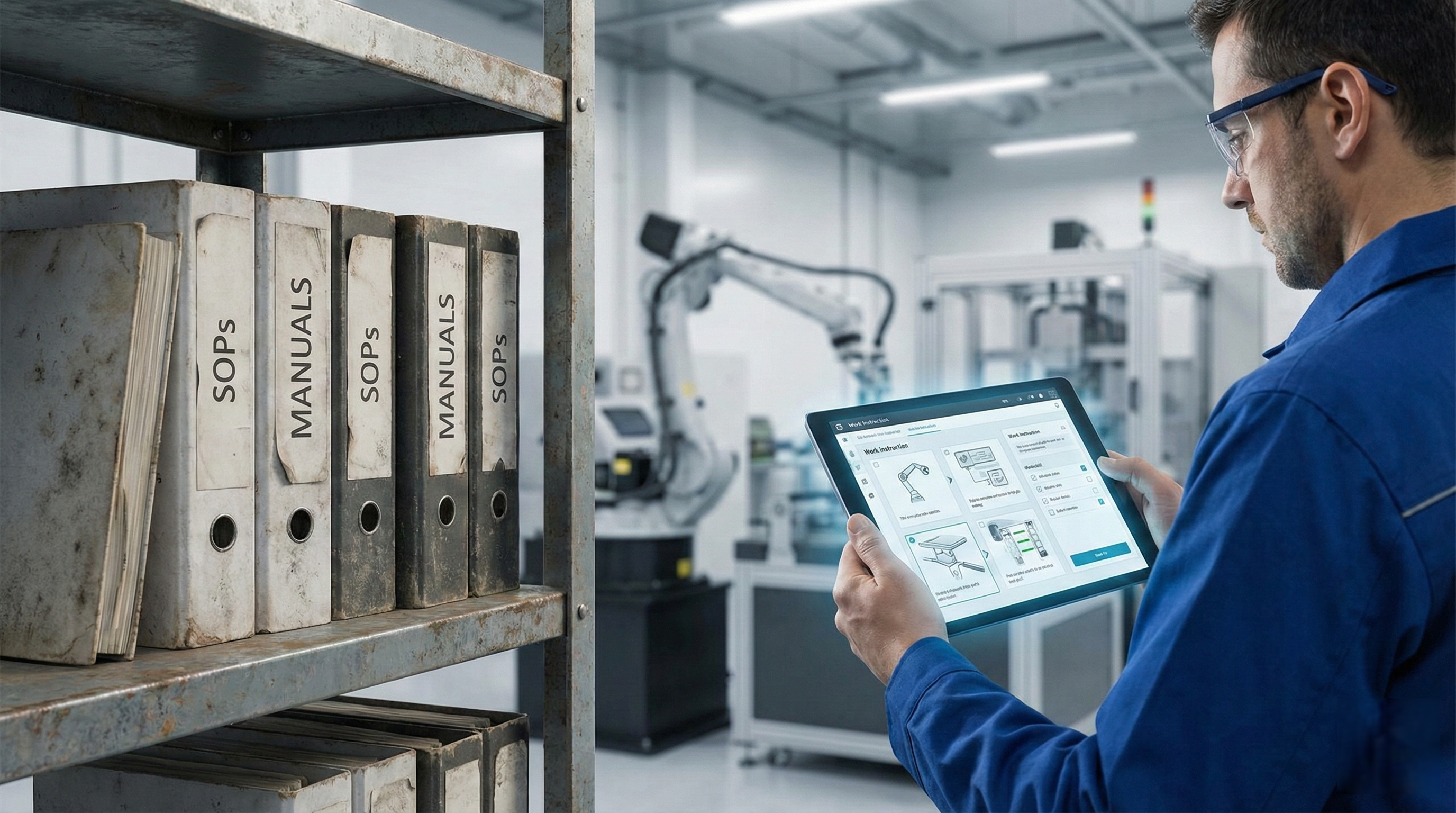
Paper Standard Operating Procedures have been around forever. Binders collecting dust on shelves. Laminated sheets zip-tied to equipment. Sign-off forms that prove someone "read and understood" a procedure they skimmed in three minutes.
The problems are well-documented at this point:
- Version control is a mess. I've walked plants where the same SOP existed in four different revisions across three departments. Nobody could tell me which one was current.
- You can't search paper. Need to find that one torque spec? Better hope you remember which binder it's in.
- Updates are painful. Reprinting, redistributing, hunting down old versions, hoping nobody's still using the one from 2019.
- No engagement data. Did they actually read it? Did they understand it? You'll never know.
- Filing cabinets full of compliance theater. Sign-off sheets proving people put pen to paper. That's it.
So organizations are digitizing. Makes sense. But here's where it gets interesting.
What Digital Work Instructions Actually Solve
Platforms like Dozuki, Tulip, SwipeGuide, and VKS address the obvious paper problems:
Updates deploy instantly. Change a procedure once, it's updated everywhere. No more version chaos.
Search actually works. Find the right instruction in seconds instead of flipping through binders.
Access from anywhere. Tablets on the floor, phones in the field, workstations at the bench.
Rich media. Videos showing exactly how to route a wire harness. Annotated photos. 3D models.
View tracking. You can see who accessed what procedure, when.
If you're still running paper, digitizing is a clear win. I'm not going to argue otherwise.
The Blind Spot Nobody Talks About
Here's what paper SOPs and digital work instructions have in common:
Showing someone what to do doesn't prove they can do it.
I watched a trainee execute a surgical stapler maintenance procedure once. Textbook form on most steps. Confident movements. But he completely skipped the sterilization sequence—steps 15 and 16—and the supervisor signed off anyway. Why? Because the supervisor was watching for the steps he expected to see, not the ones that got missed.
That's the gap. Digital work instructions can tell you:
- The technician accessed the procedure
- They viewed all 12 steps
- They spent 8 minutes on the page
What they can't tell you:
- Did they actually perform each step correctly?
- Can they do it without the instructions in front of them?
- Would they pass an audit tomorrow?
Training managers call this the "they watched the video" problem. There's a canyon between "completed training" and "competent to perform." Every quality manager I've met knows this gap exists. Most just hope it doesn't bite them.
The Comparison That Actually Matters
Forget paper vs digital for a second. The real comparison is passive documentation vs active validation.
| Aspect | Paper SOPs | Digital Work Instructions | Skills Validation |
|---|---|---|---|
| Accessibility | Poor | Good | Mobile-first |
| Version control | Manual nightmare | Automatic | Automatic |
| Engagement tracking | Signatures only | Views and time | Actual performance |
| Proves competency | No | No | Yes |
| Audit evidence | Paper trail | Access logs | Validated proof |
| When procedures change | Retrain manually | Retrain manually | Re-validate affected workers |
The bottom row is where it matters. Paper and digital both require you to trust that viewing equals understanding equals ability. Skills validation doesn't require that trust—it verifies.
What Validation Actually Looks Like
Instead of "read this and sign here," imagine:
- Worker reviews the training content (video, instructions, whatever)
- They perform the actual task—real equipment or realistic simulation
- System observes and validates each critical step was executed correctly
- You get proof of competency, not proof of attendance
- When procedures update, workers who need re-validation get flagged automatically
This is what's missing from both paper SOPs and digital work instructions. The ability to answer one question: "Can this person actually do this job correctly right now?"
Not "did they complete training." Not "did they sign the form." Can they do it.
When Digital Is Enough (And When It Isn't)
Digitize your SOPs if:
- You're still on paper (just do it)
- You need better version control
- Your primary goal is documentation and reference
Add skills validation when:
- You need to prove competency for audits or compliance
- "They completed training" isn't sufficient evidence anymore
- Quality issues keep tracing back to inconsistent execution
- You're tired of the gap between training records and actual performance
If you're in a regulated industry—medical devices, aerospace, pharma—you probably already feel the compliance pressure. If you're in general manufacturing, the pressure's coming. With 2.1 million manufacturing positions projected unfilled by 2030, organizations can't afford to guess whether their people are actually competent.
The Bottom Line
Digital work instructions are better than paper. If that's your choice, go digital. No argument here.
But if you need to prove competency—for compliance, for quality, for your own confidence—documentation isn't enough. You need validation.
The future isn't paper vs digital. It's documentation vs proof. And proof wins every time.